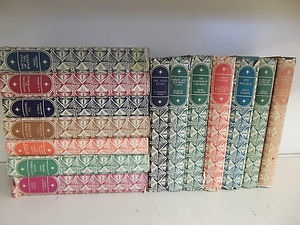
Examples of the Companion Book Club
It was my Grandmother’s fault, really. She loved a book, and passed on that love of books to me. I think from the time that I could cruise around the living room in her cottage, I could spy the lovely patterns on the dust covers of the books on the glass-doored bookcase. Not for me, then, books, aged one. No, the black cat held more interest; Maxine, my cousin would hold one end, and I would hold the other. I think the screams of all three of us put paid to further exploration of the cat-as-a-long-doorstop. A happy infancy, then….where were we? Ah….those books.
In 1956 or thereabouts, one of the family seems to have bought my grandmother a subscription for 6 months for 30/- (that is £1.50 in your current AngloPeso) to the Companion Book Club. The Companion Book Club, or CBC as I shall refer to it from now on, had been founded in 1952, with a view to taking the best sellers of a year earlier, and then reprinting them for offer to their members…or subscribers. Not that innovative an idea when viewed from the other side of the subscription and part-work frenzy of the 1970’s and 1980’s, but for the time, these half-price books met a demand in a post war austerity society.
The books were of good quality, with good boards, a clear (and to my mind, very pleasing) spine and it was an easy way for people to read current novels, and I suppose, create a library. The dust covers from 1952 to 1963 all followed the same pattern, with a geometric design, and so far as I can ascertain, the actual boards and spine design only changed towards the end of the 1960’s. It is said that good design doesn’t age, and there is your proof, I suppose.
None of the novels are what you might call beacons of the mid 50’s novel landscape, though, and the works of Joy Packer, Hammond Innes and Howard Spring are long forgotten. They aren’t without their charm, though. Occasionally there were ‘proper’ authors, like W. Somerset Maugham, Alistair MacLean and John Steinbeck – but the majority of the authors are no longer numbered among the literary illuminati.
Odhams Press, the company behind the CBC, maintained a quiet yet steady increase in business by the look of things; after their first year, they had moved to larger premises in Long Acre in WC2, and after ten years or so, absorbed another company, the Popular Book Company into their fold. Persistence marketing was conducted in the form of a pamphlet with each order, which told the reader in clipped stentorian tones that they were doing the right thing, saving money and printed a number of accolades of the sort “Marvellous – Mrs A.B., Ealing”. This pamphlet, The Companion, as it was known, published a list of the forthcoming novels that were in the pipeline for the next 6 months (remember the 30/- earlier for the 6 month subscription?) and carried various short articles about this month’s author or book. I assume that the back pages of the Daily Express carried adverts for the CBC, which ensured a fresh flow of subscribers.
I’d learnt to read, and books appeared at every visit to my Grandmother. A smile on her face at my joy at yet another night spent under the covers with a torch makes me think that she knew the way I thought. For me, the reading was always the reward. I think she was pleased that I consumed the Enid Blyton nonsense quickly, and when I was 8, I was allowed to read “Fly for your Life” by Larry Forrester. This was the epitome of a boy’s derring-do book, being the biography of Bob Stanford Tuck, the WW2 RAF ace. I was hooked. I consumed anything with a military biography bent, (Montgomery, Bader, The D-Day Landings) and moved swiftly on to the novels that were extant in the bookcase. I read my Grandmother’s collection in about 6 months. I wasn’t allowed to have “Zoo quest for a dragon” by David Attenborough on account of the colour plates of African ladies, but everything else was fair game. My own private library….
Today, the books are worth next to nothing, not being first editions, or indeed, not being published by the original publisher. This makes them a target for me, and I have, over the years, come to dream of a bookcase containing all these books. The shock of paying 10p at a car boot sale last year for 12 of the things made me realise that the collecting of something has it’s own pleasure, and it matters not that the collection has no value. No, the nostalgia pays the urge to collect, but in this case, you get to read some great examples of the art of the novel, circa 1950.
The CBC fuelled my love of reading, together with the Ladybird imprints and the Sparky and Beano. Cheers, Nanny, and thanks. Oh, and thank you, the wise minds behind the CBC, for being instrumental in my literacy.
 richardsandwell
Am just reading a Wilbur Smith from the Companion Book Club which my father subscribed to. I have boxes of these books, which I am getting through and my love of reading came from him
Thankyou Dad xxx